
Table of Contents
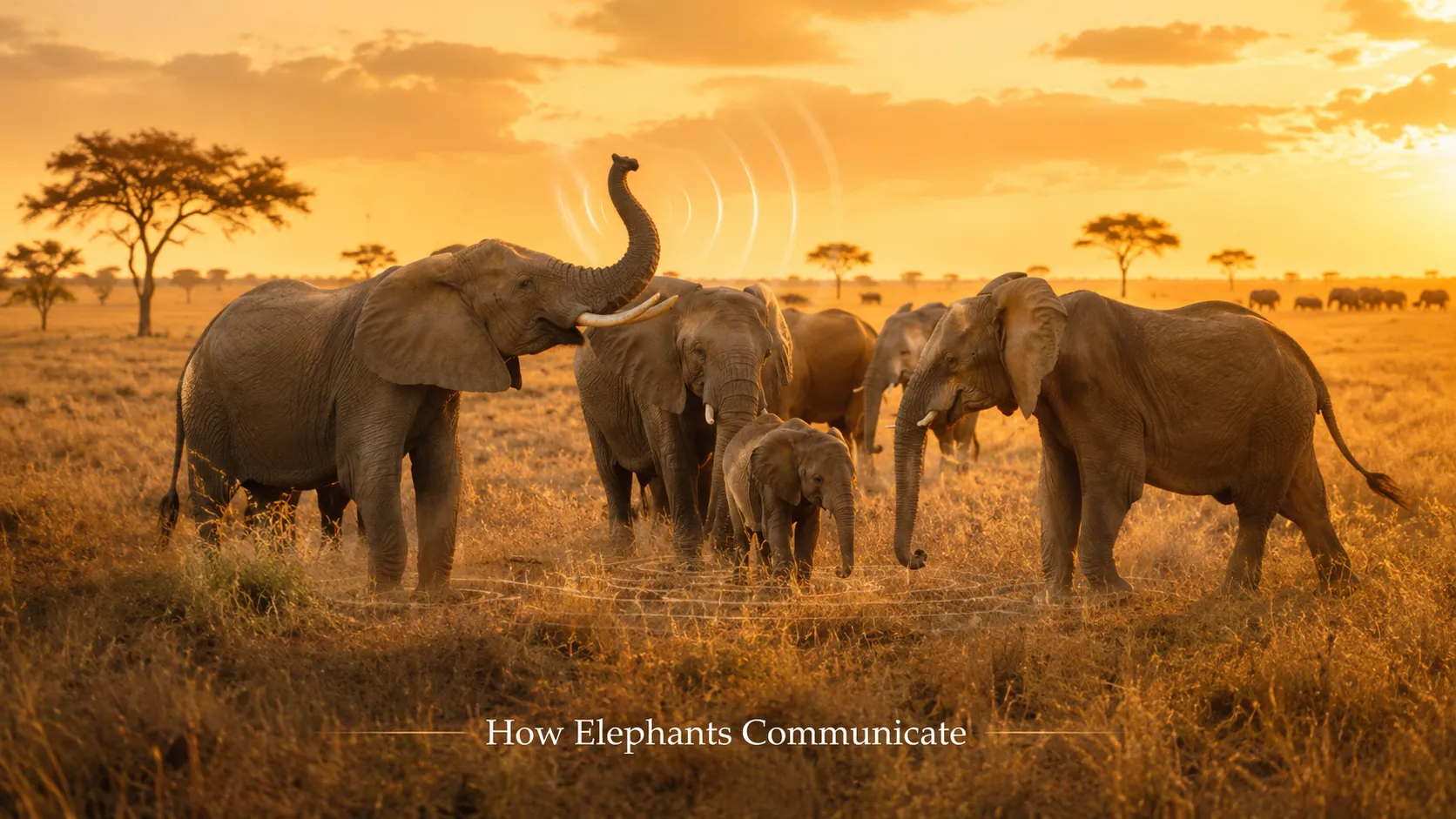
Elephants are among the most sophisticated communicators in the animal kingdom. Understanding how elephants communicate reveals a complex, multi-layered system that scientists are still decoding today. These animals use sound frequencies below human hearing, powerful body signals, and chemical cues to coordinate herds, warn of danger, and strengthen social bonds often across distances of up to 10 kilometers.
Research published in Animal Behaviour in 2014 confirmed that African savanna elephants produce over 70 distinct vocalizations. Add seismic rumbles, trunk gestures, and ear positions into the mix, and it becomes clear that elephant communication rivals the complexity of primate social signaling in depth and function.
The Science Behind Elephant Infrasound
What Is Elephant Infrasound?
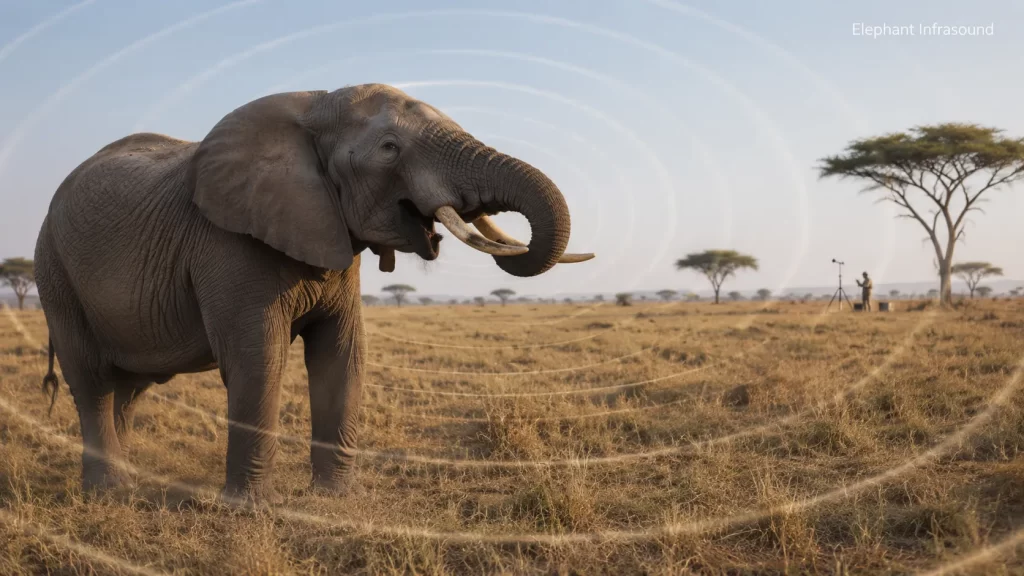
Elephant infrasound refers to low-frequency sound waves below 20 Hz, the lower limit of human hearing. Elephants produce these calls in the larynx and project them outward through the skull and nasal passages. Dr. Katy Payne of Cornell University first identified elephant infrasound in 1984 while observing Asian elephants at Washington Park Zoo. She noticed a palpable throbbing in the air that corresponded with elephant behavior, even when no audible call was detected.
Studies show that elephant infrasound calls typically fall between 14 Hz and 35 Hz. These frequencies travel efficiently through both open air and dense vegetation. Ground-dwelling seismic waves, a subset of infrasound, carry even farther up to 32 kilometers under ideal conditions, according to research by Cynthia O’Connell-Rodwell at Stanford University.
How Far Can Elephant Infrasound Travel?
The range of elephant infrasound depends heavily on environmental conditions:
- Open savanna, calm air: calls travel up to 10 km through the air.
- Seismic ground waves: signals detected up to 32 km away.
- Forest environments: range reduced to 1–4 km due to vegetation interference.
- Nighttime conditions: low ambient noise allows signals to carry 20–30% farther.
Elephants detect these ground vibrations through their feet and trunks. Pacinian corpuscles, specialized pressure receptors in the sole of each foot, pick up seismic signals. Research from 2001 in the Journal of the Acoustical Society of America confirmed that elephants shift weight to their front feet and become very still when receiving seismic communication, indicating deliberate reception behavior.
Elephant Rumbles: The Primary Vocal Signal

Types of Elephant Rumbles
The elephant rumble is the most versatile call in the elephant’s vocal repertoire. Researchers at the Amboseli Elephant Research Project in Kenya, active since 1972, have catalogued rumbles into several functional categories:
| Rumble Type | Frequency Range | Typical Context | Estimated Range |
|---|---|---|---|
| Contact rumble | 14–20 Hz | Herd cohesion, location calls | Up to 10 km |
| Greeting rumble | 20–30 Hz | Social bonding on reunions | Up to 1 km |
| Musth rumble (males) | 14–18 Hz | Mating advertisement | Up to 10 km |
| Distress rumble | 25–80 Hz | Danger, separation | Up to 5 km |
| Let’s go rumble | 20–35 Hz | Group movement initiation | Up to 2 km |
The “let’s go” rumble is especially well-documented. A matriarch uses it to signal the herd to move. Studies by Dr. Joyce Poole, co-founder of ElephantVoices, show that herds respond to this call 75% of the time within 30 seconds of hearing it.
Musth Rumbles in Male Elephants
Male elephants in musth, a testosterone-driven reproductive state, produce a specific low-frequency rumble called the musth rumble. Testosterone levels during musth can be 60 times higher than baseline. This call functions as a broadcast signal, advertising reproductive readiness to females and warning rival males. Females show a measurable preference for musth males. Research in Hormones and Behavior (2011) found that female elephants moved toward musth rumble playback 80% of the time during controlled trials.
Elephant Body Language: Reading the Signals
Key Ear and Trunk Signals
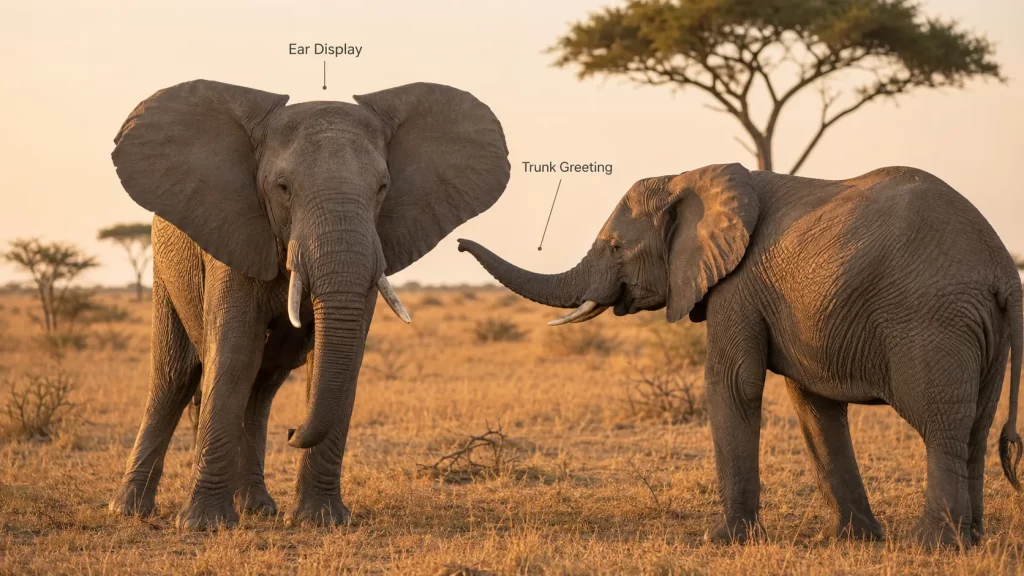
Elephant body language is a critical communication channel, especially at close range. Ear position, trunk movement, and overall posture convey specific messages to other elephants and serve as an alert system for researchers.
Key body language signals include:
- Ears spread wide and held out: Threat display; increases perceived body size by up to 30%.
- Ears folded back flat: Submission, fear, or retreat signal.
- Trunk raised and curled inward: Sniffing for chemical signals; active information-gathering.
- Trunk extended toward another elephant: Greeting behavior; contact is typically directed at the mouth or temporal gland.
- Head low and ears back, slow approach: Submission in a confrontation.
- Foot scraping or pawing the ground: Agitation or pre-charge warning.
Dr. Frans de Waal, a primatologist at Emory University, noted in his 2019 book Mama’s Last Hug that elephant body language shows strong parallels with great ape signaling, particularly in the precision of trunk gestures used for reassurance, pointing, and directed attention.
Temporal Gland Secretions and Chemical Communication
Chemical communication plays an underappreciated role in how elephants communicate. The temporal gland, located between the eye and ear, secretes a dark fluid during periods of stress, musth, and heightened social arousal. Both male and female elephants produce temporal gland secretions, but the composition varies significantly by sex and reproductive state.
A 2006 study in Physiology & Behavior identified over 40 volatile organic compounds in elephant temporal secretions. Musth fluid in males is rich in frontalin, a bicyclic compound that functions as a long-range chemical signal. Females detect and respond to these compounds using the vomeronasal organ, a chemosensory structure in the roof of the mouth accessed by the flehmen response (a lip-curl motion).
Seismic Communication: The Ground-Based Channel
How Elephants Use Seismic Signals
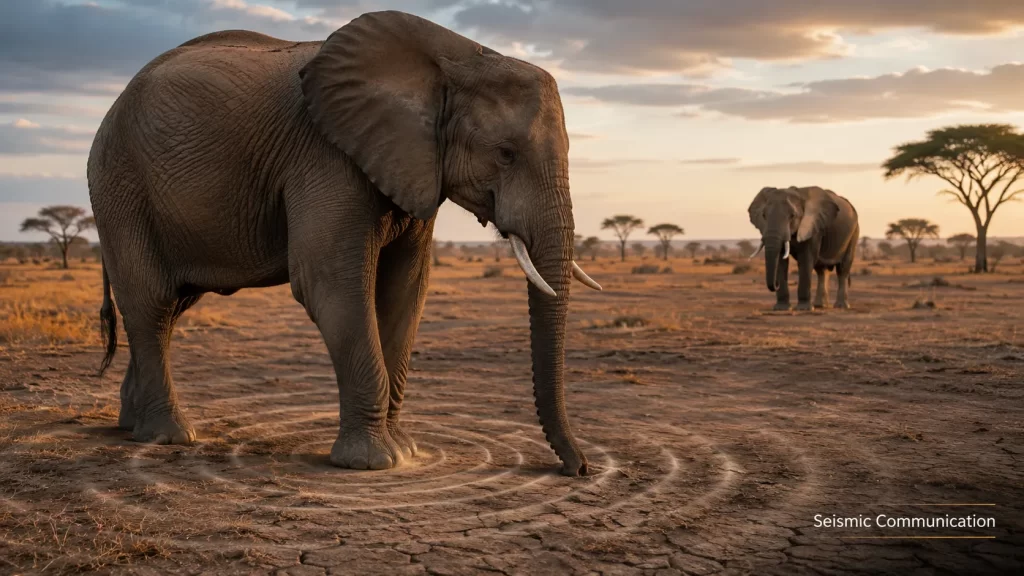
Seismic communication is perhaps the least understood but most remarkable channel in elephant communication. When an elephant produces a loud, low-frequency rumble or stomps the ground, it generates both airborne sound waves and ground-propagating seismic waves. These two signals travel at different speeds: sound at approximately 340 m/s through air, seismic waves at 250–300 m/s through soil.
O’Connell-Rodwell’s field research in Namibia’s Etosha National Park between 1997 and 2004 demonstrated that free-ranging elephants respond to playback of seismic signals from their own family groups. Subjects showed clear orientation toward the source, increased vigilance, and coordinated movement even when airborne sound was masked. This confirmed that seismic communication functions as an independent, functional channel.
Practical Implications for Elephant Conservation
Understanding seismic communication has direct applications in elephant conservation:
- Anti-poaching: Seismic sensors can detect distress signals and alert rangers within minutes.
- Conflict mitigation: Identifying when elephant groups are communicating allows land managers to predict movement and reduce human-wildlife conflict.
- Translocation: Replaying familiar family rumbles via seismic arrays reduces stress in translocated elephants by up to 40%, according to preliminary trials in South Africa.
How Elephants Communicate Across Generations

Social Learning and Matriarchal Knowledge
How elephants communicate is not purely instinctive; it involves significant social learning. Young calves absorb communication patterns by observing older herd members, particularly the matriarch. A 2008 study in Animal Behaviour found that herds with older matriarchs (over 50 years) responded more appropriately to lion threat playbacks than younger-led herds. Older matriarchs carry a richer library of learned responses and communicate them to the herd through posture, rumble, and movement cues.
This knowledge transfer is one reason poaching of older elephants has such a destabilizing effect on herd behavior. Loss of a matriarch disrupts both the social structure and the encoded communication knowledge that the herd depends on.
Bottom Line
Elephant communication is a multi-channel system of remarkable precision. Infrasound carries herd contact calls across 10 kilometers. Seismic signals extend that range to 32 km through the ground. Rumbles cover everything from greeting to reproductive signaling. Body language and chemical cues fill in the short-range picture. Together, these channels form a communication network shaped by millions of years of evolution and refined through decades of social learning within each herd. As research tools improve from infrasound recorders to ground-mounted seismometers, we continue to decode a language that has existed far longer than our own.