
Table of Contents
Verizon Communications launched what stands as the company’s most significant workforce reduction in its history on November 20, 2025, with confirmed layoffs affecting more than 13,000 employees across the organization. This restructuring represents approximately 13% of Verizon’s workforce, affecting roughly 20% of its non-union management staff at a company that employed approximately 100,000 workers at year-end 2024.
New Chief Executive Officer Dan Schulman, who assumed leadership in early October 2025 after years of service on Verizon’s board and a prominent tenure leading PayPal, communicated the decision through an internal memo to staff.
The layoffs commenced immediately, with U.S.-based employees receiving notice on Thursday, while international employees would be informed in the weeks following the announcement.
The Competitive Pressures Driving Restructuring
Verizon faces unprecedented competitive challenges in the wireless and broadband markets that have forced management’s hand toward aggressive cost-cutting measures. During the third quarter of 2025, Verizon reported a net loss of 7,000 postpaid subscribers a concerning metric in the highly competitive U.S. wireless market. This contrasts sharply with rival performance: T-Mobile added over 1 million postpaid subscribers in the same period, while AT&T gained 405,000 customers.
The subscriber losses compound existing challenges. T-Mobile now stands within striking distance of Verizon’s historically dominant position, with approximately 140 million subscribers compared to Verizon’s 146 million. Industry analysts suggest T-Mobile could potentially surpass Verizon in total subscribers by late 2026 if current trends continue.
Schulman addressed this competitive reality directly on the company’s most recent earnings call, stating that “Verizon is clearly falling short of our potential” and emphasizing that the “primary objective is to build loyalty and drive significant improvements in retention.” He further noted that “Verizon will no longer be the hunting ground for competitors looking to gain share” and described a need to make the company “more agile and efficient.”
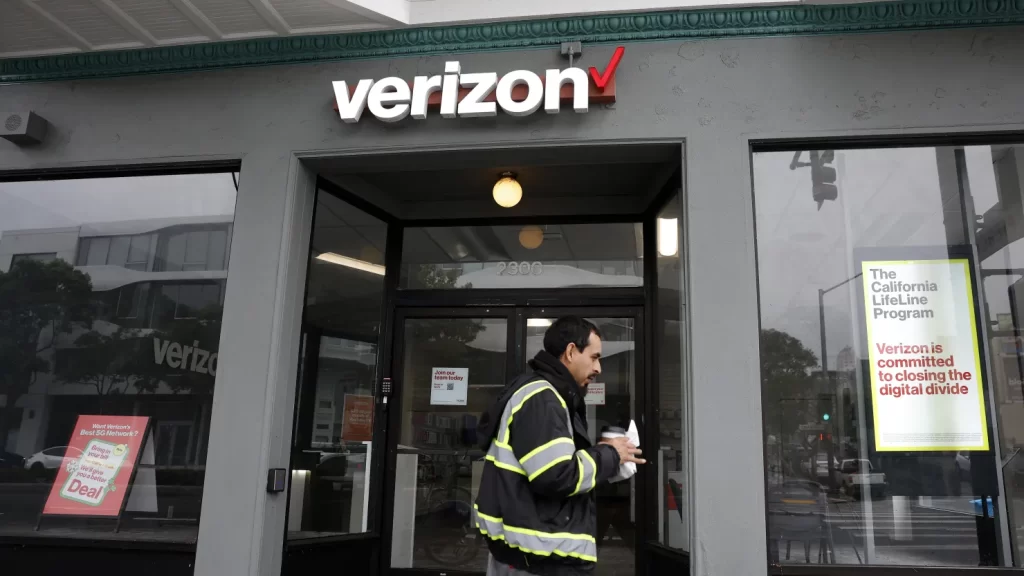
Justin Sullivan | Getty Images
Cost Structure Constraints and Operational Inefficiencies
In his memo to employees, Schulman identified Verizon’s cost structure as a fundamental obstacle to competitive recovery. He wrote: “Our current cost structure limits our ability to invest significantly in our customer value proposition.” This constraint has prevented the company from investing adequately in customer experience improvements and market competitiveness.
Beyond workforce reductions, Verizon plans to substantially reduce expenses related to outsourced labor and external service providers. The company will also convert approximately 179 to 200 company-owned retail stores into franchised operations, shifting those employees off Verizon’s payroll.
Schulman emphasized that operational complexity has created friction with customers and slowed decision-making velocity. He stated: “We must simplify our operations to address the complexity and friction that slow us down and frustrate our customers.”
Historical Context: This Layoff’s Unprecedented Scale
The current reduction represents the largest single-round workforce cut in Verizon’s corporate history. However, this announcement should be understood within a broader trend: over the previous three years, Verizon had already eliminated nearly 20,000 positions. In 2024 alone, a voluntary exit program reduced headcount by 4,800 employees and incurred a charge of approximately $2 billion.
The layoff’s scale becomes clearer in comparative context. With approximately 100,000 employees at fiscal year-end 2024, cutting 13,000-15,000 positions represents a dramatic organizational reset unmatched in recent Verizon history.
Strategic Goals: Speed, Focus, and Customer-Centricity
Schulman framed the restructuring as essential to transforming Verizon’s operational model. In his communication to staff, he stated: “The actions we’re taking are designed to make us faster and more focused, positioning our company to deliver for our customers while continuing to capture new growth opportunities.”
The new CEO has emphasized creating a “simpler, leaner, and scrappier” organization where cost discipline becomes foundational. At the recent all-hands meeting, Schulman declared: “Cost reductions will be a way of life for us here” and acknowledged Verizon sits at a “critical inflection point.”
Every business segment will experience structural change. As Schulman noted in his memo: “Every part of the company will experience some level of change, and we will have conversations with every affected employee to ensure they are treated with the utmost respect and care.” Don’t miss our recent post about news.
Employee Support Initiatives
Recognizing the impact of this significant transition, Verizon established a $20 million Reskilling and Career Transition Fund for departing employees. This fund focuses specifically on “skill development, digital training and job placement to help our people take their next steps.”
Notably, Verizon positioned this fund as the first major telecom initiative specifically addressing skill development for the age of artificial intelligence. The company emphasized that job cuts are not driven by AI implementation but rather reflect broader economic and competitive pressures.
Broader Economic Context
Verizon’s restructuring occurs amid a wave of significant corporate layoffs across multiple sectors. Amazon, UPS, and Nestlé have all announced substantial workforce reductions. Economic factors contributing to these layoffs include rising operational costs tied to new tariffs and shifting consumer spending patterns.
Schulman acknowledged this broader context in his communication: “Changes in technology and in the economy are impacting the workforce across all industries. We see it in our families and within our communities.”
Market Response and Strategic Vision
Following the announcement, Verizon’s stock price remained relatively flat on trading day, suggesting investor acceptance of the restructuring plan. Industry analysts have watched closely to assess whether cost reductions will effectively offset increased expenses associated with customer retention and competitive pricing pressures.
Craig Moffett, a senior analyst at MoffettNathanson, framed the central question: cost cuts must counterbalance the higher customer acquisition and retention expenses that Verizon will likely incur to stop subscriber losses.
What Comes Next for Verizon
The next critical period for Verizon spans the fourth quarter of 2025 and early 2026. Schulman emphasized in his message: “The fourth quarter is an extremely important one for us, so I appreciate everyone bearing down to make it a great one, even in the face of change.”
During this timeframe, Verizon will communicate new organizational structures, refined priorities, and strategic direction to remaining staff. The company simultaneously works toward completing its $20 billion acquisition of Frontier Communications, expected to close in early 2026, which should strengthen its competitive position in broadband and fiber-to-the-home services.
Verizon has also launched competitive promotional initiatives to stabilize subscriber growth. These include a “Bring Your Bill” campaign inviting AT&T and T-Mobile customers to compare plans, along with price-matching guarantees on popular streaming services.
Key Takeaways
Bottom Line
Verizon’s announcement of layoffs exceeding 13,000 positions marks a defining moment for the telecommunications giant as it confronts evolving market dynamics and intensifying competitive pressure. Under new leadership, the company has embraced a comprehensive restructuring strategy designed to accelerate decision-making, reduce operational complexity, and preserve financial resources for customer-facing investments.