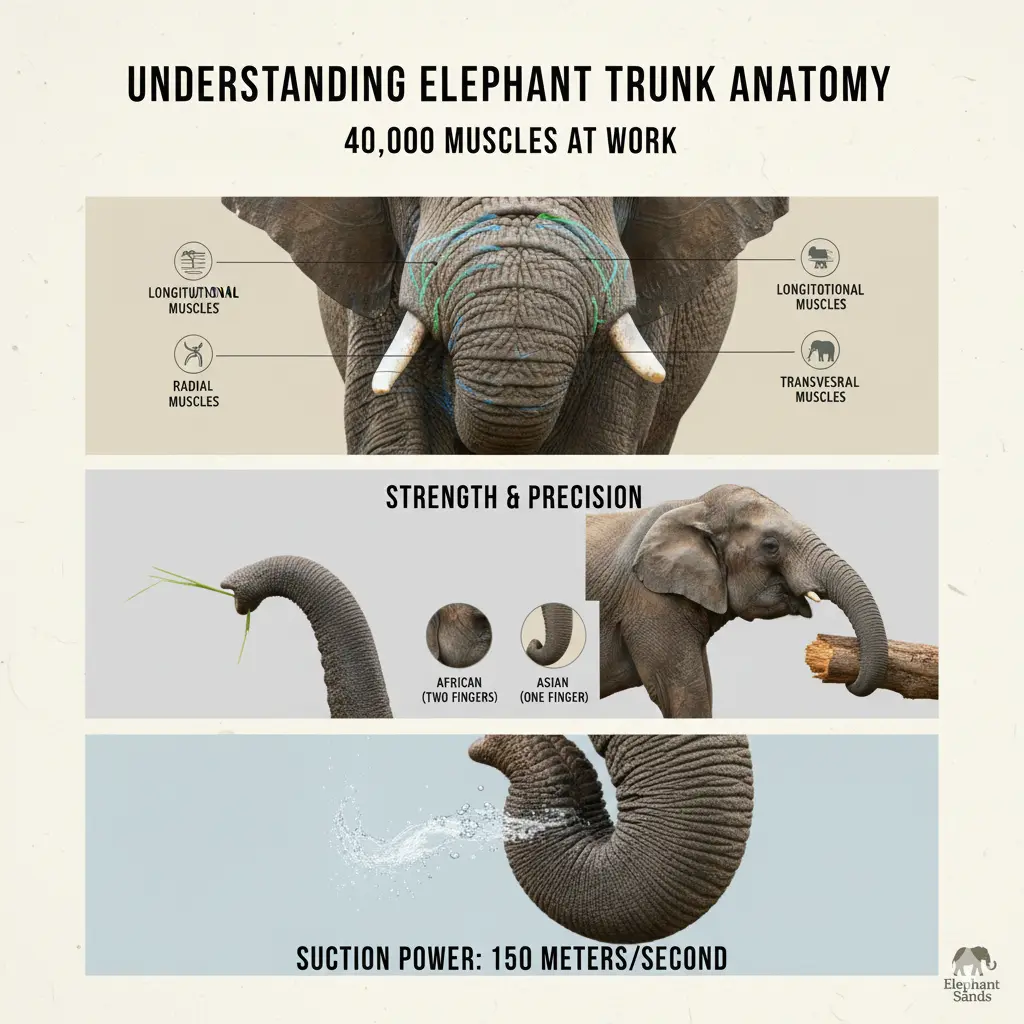
The elephant trunk is perhaps the most versatile “multitool” in the natural world. While the human body contains roughly 639 muscles in total, an elephant’s trunk boasts an incredible 40,000 individual muscle fascicles (some recent research even suggests up to 90,000 tiny bundles). This complex muscular network allows an elephant to perform tasks ranging from uprooting massive trees to plucking a single blade of grass with surgical precision.
1. The Science of the “Muscular Hydrostat”
The trunk is what scientists call a muscular hydrostat. This means it contains no bones or joints. Instead, it maintains its shape and movement through the incompressible nature of its own fluid-filled muscle cells. Similar to a human tongue or an octopus tentacle, the elephant trunk relies on the coordination of three main muscle types:
- Longitudinal Muscles: Located on the surface, allowing the trunk to shorten and curl.
- Radial Muscles: Extending from the center outward, allowing the trunk to thin and elongate.
- Oblique Muscles: Wrapping around the trunk to facilitate twisting and complex spiraling movements.

2. Force vs. Finesse: The Trunk in Action
The dexterity of the trunk is essential for the daily survival of the species. An elephant uses this “fifth limb” for more than just breathing; it is the primary tool for nutrient acquisition.
During the harsh “brown season,” the trunk’s strength is put to the test. When food is scarce, elephants must use their trunks to manipulate vegetation that is difficult to process. As discussed in our analysis of what elephants eat in the dry season, the trunk provides the immense grip strength needed to strip fibrous bark and uproot moisture-rich tubers when grass disappears.
3. The Trunk as a Precision Pump
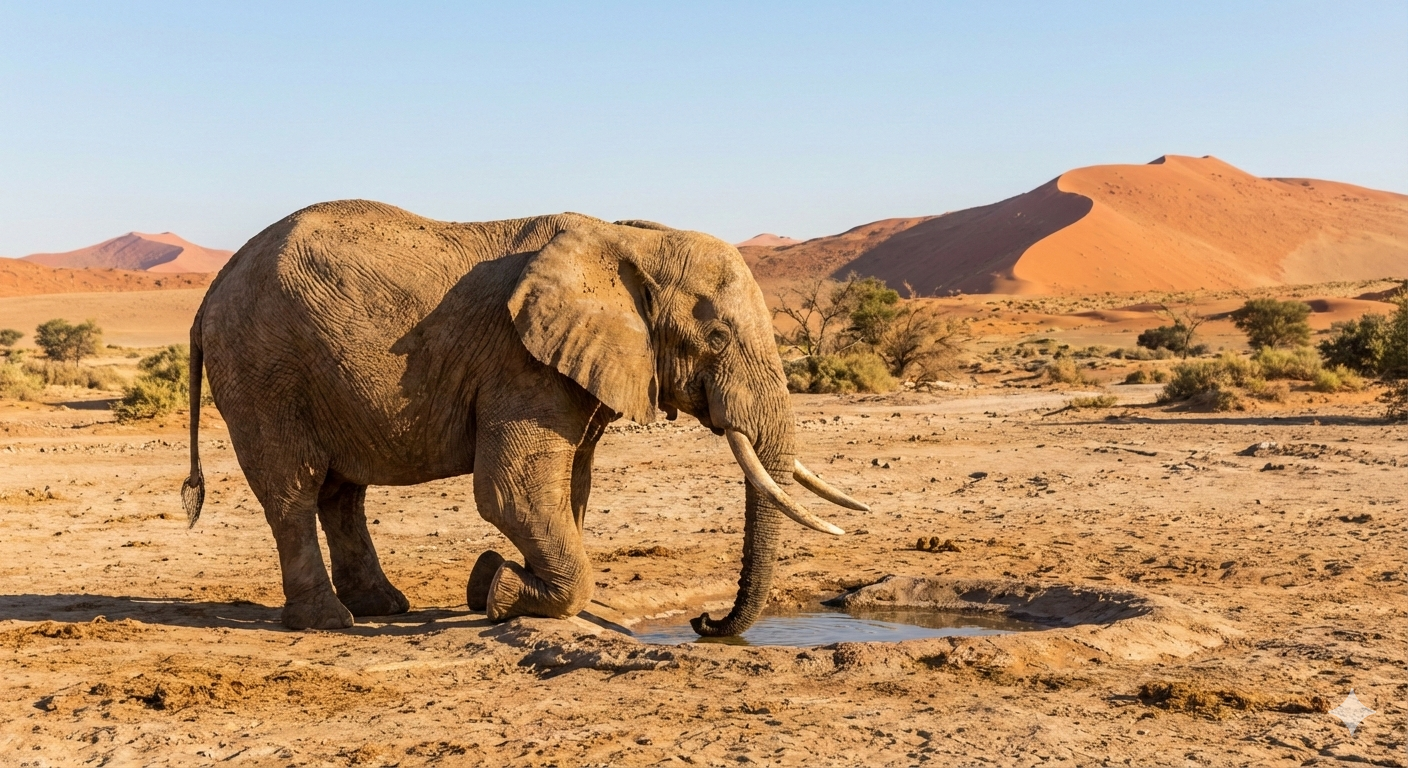
One of the most critical functions of trunk anatomy is its role in hydration. The trunk can suck up nearly 10 liters of water in seconds, acting as a high-pressure reservoir.
This suction capability is vital for survival in arid landscapes. In Namibia and Mali, where water sources are rare, the trunk’s efficiency determines how much water a desert-adapted elephant drinks during its short time at a watering hole. Without the muscular coordination to draw up large volumes quickly, these elephants would succumb to the desert heat before they could fully rehydrate.
4. Skeletal Anchor and Leverage
Although the trunk itself is boneless, it is anchored to the skull and supported by the elephant’s facial structure. The trunk often works in synergy with the tusks to provide leverage. When an elephant needs to move a heavy log or defend itself, the trunk wraps around the object while the tusks act as a solid fulcrum.
Understanding the difference between elephant tusk vs bone is essential here; the dense, mineralized dentine of the tusk provides the rigid strength necessary to withstand the torque and pressure applied by the 40,000 muscles of the trunk during heavy-duty labor.
5. Species-Specific Trunk Features
While all elephants share this incredible anatomy, there are slight variations depending on the lineage. For instance, the African species have two “fingers” at the tip of the trunk for a pincer-like grip, while Asian elephants have only one. These evolutionary differences are explored further in The Definitive Guide to Elephant Species.
Watch: The Physics of the Trunk
To see the incredible 40,000 muscles in action, this scientific breakdown shows how the trunk handles both extreme weight and delicate objects: