Table of Contents
Elephant migration shapes ecosystems across Africa and Asia. Yet fences now block many of these historic routes. As of 2026, Africa holds about 415,000 savanna elephants, while Asia supports roughly 52,000 wild Asian elephants. Both populations depend on seasonal elephant migration to access food, water, and mates.
Over the last 30 years, protected areas expanded, but so did fencing. Southern Africa alone has more than 20,000 kilometers of game fencing. India has installed over 3,000 kilometers of electric fences to reduce crop raids. These barriers reduce conflict, but they also disrupt natural movement.
Scientific studies published between 2022 and 2025 confirm that fences limit gene flow and increase isolation. Research in Conservation Science and Practice (2022) and MDPI (2023 review) shows measurable genetic differentiation in fenced elephant populations. When elephant migration slows or stops, long-term genetic health weakens. This article explains how fencing affects elephant migration, survival, and genetic resilience in 2026.
How Fences Disrupt Elephant Migration Patterns
Physical Barriers and Fragmented Landscapes
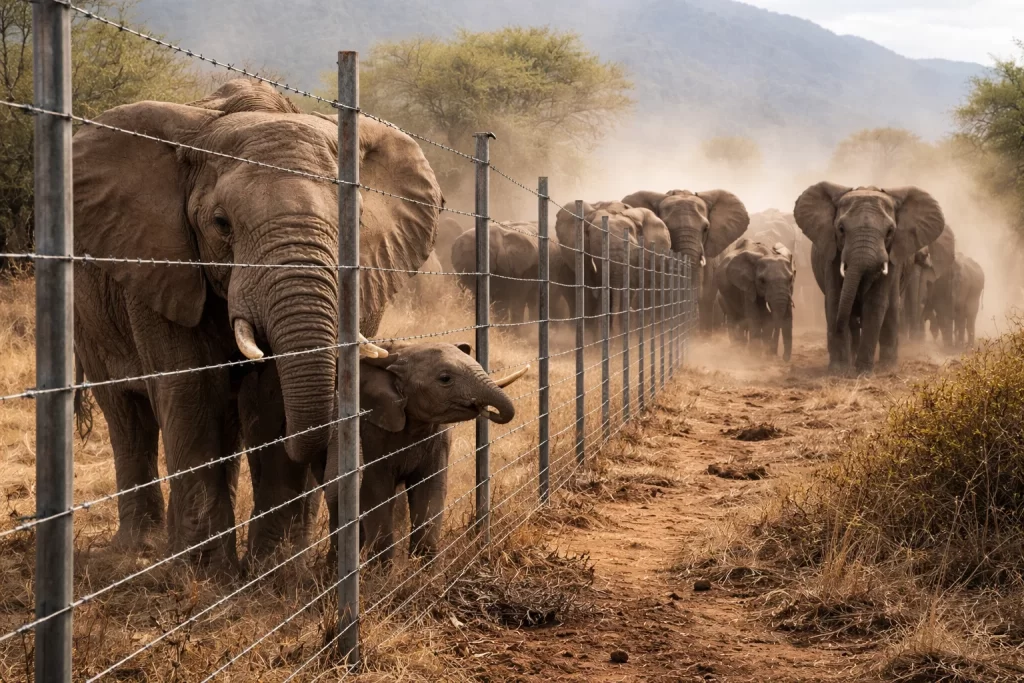
Fences interrupt elephant migration by blocking seasonal routes used for centuries. Elephants can travel 20 to 50 kilometers per day during peak movement. In dry seasons, herds may cover 1,000 kilometers annually. When fences block corridors, elephants become confined to smaller ranges.
In southern Africa’s private reserves, veterinary and anti-poaching fences often surround parks. A 2022 Frontiers in Conservation Science study found that fenced reserves reduced elephant home ranges by up to 40%. Restricted movement increases pressure on vegetation and water sources. Habitat degradation then follows.
In India, electric fences aim to protect farms. However, research on Asian elephants shows that fenced protected areas experience lower connectivity between subpopulations. According to a 2023 study on ResearchGate, fencing altered gene flow within protected landscapes. Elephant migration declines when landscapes are fragmented, and fragmentation reshapes elephant behavior permanently.
Behavioral Shifts and Human Conflict
Elephants adapt quickly to new barriers. Some break fences, leading to human-elephant conflict. Others avoid blocked routes entirely. In Kenya and Botswana, conflict incidents increased by over 15% between 2023 and 2025 in regions with partial fencing.
Restricted elephant migration also forces herds into farmland corridors. The International Union for Conservation of Nature reports that crop-raiding incidents in South Asia remain one of the top threats to Asian elephants in 2026. Barriers that fail to maintain corridors increase tension rather than reduce it.
Genetic Health and the Cost of Isolation
Reduced Gene Flow in Fenced Populations
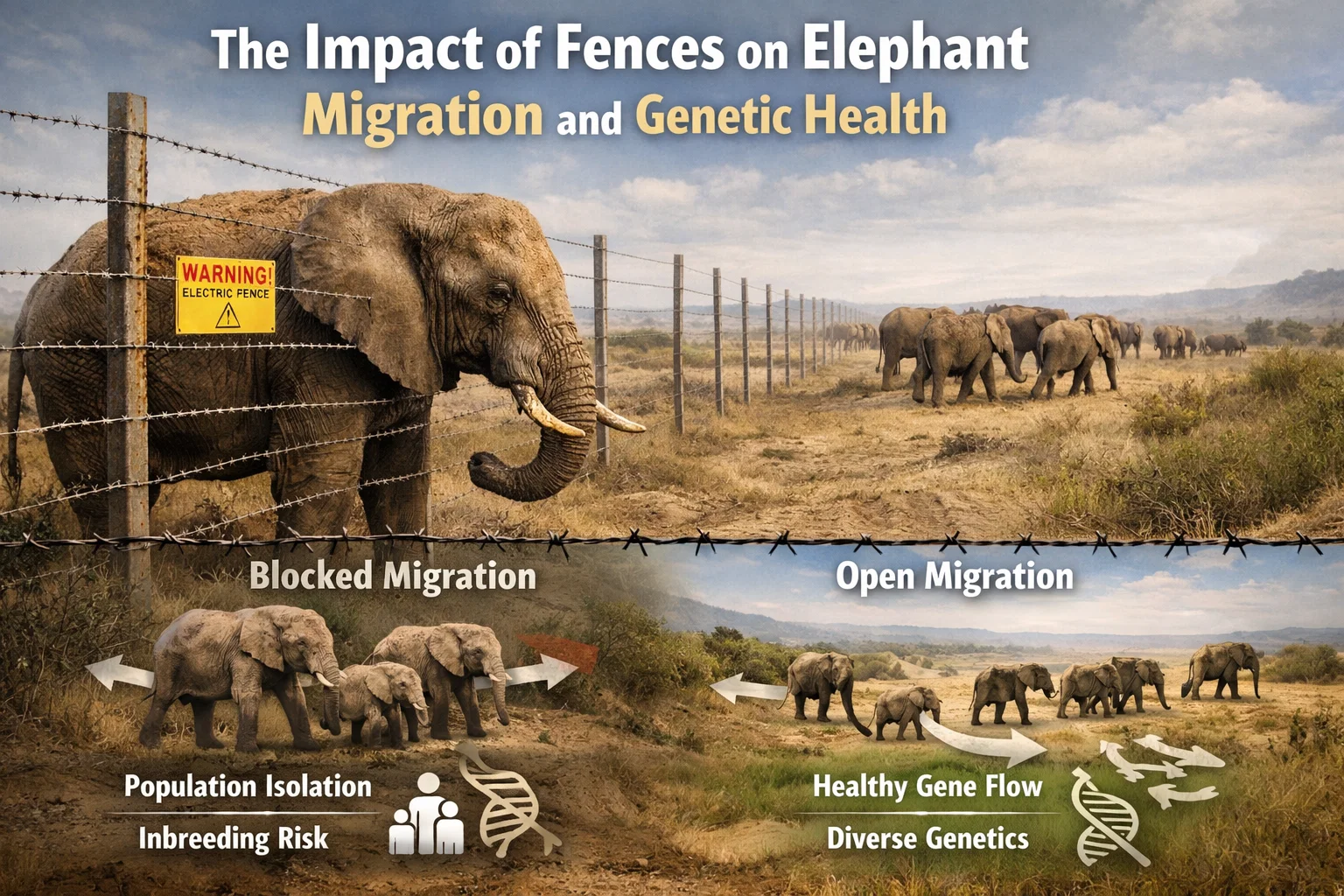
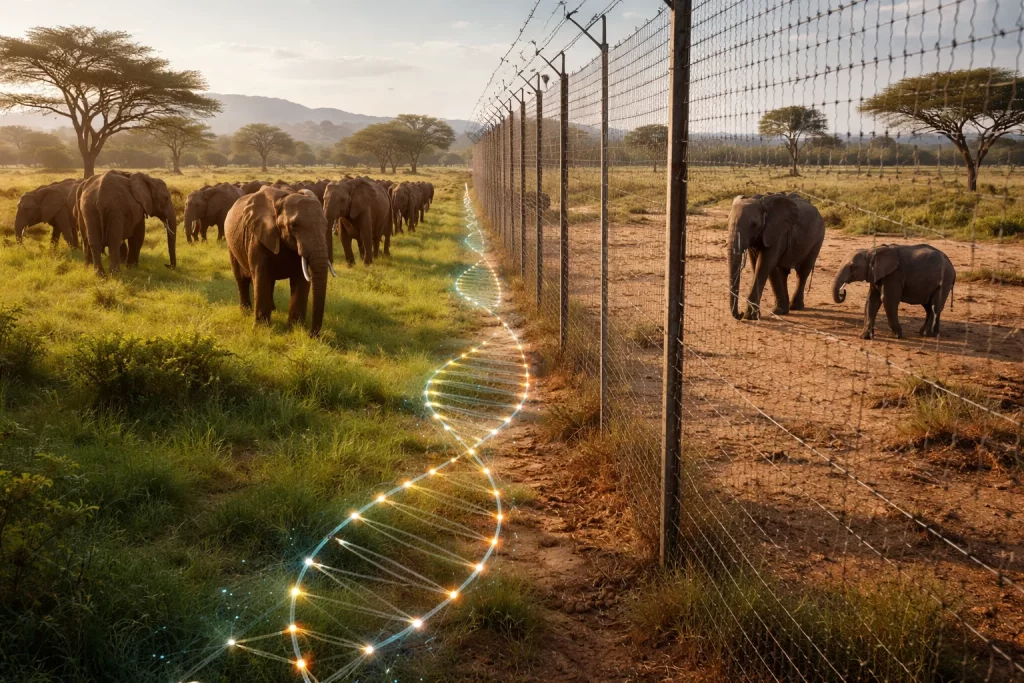
Genetic diversity allows species to adapt to disease and climate change. Elephant migration plays a vital role in mixing genes across landscapes. When fences isolate herds, breeding occurs within smaller pools.
A 2022 peer-reviewed study in Frontiers in Conservation Science measured genetic differentiation in fenced Asian elephant populations. Researchers detected increased genetic structuring within only two generations. Another 2025 PubMed-listed study confirmed that fenced populations showed lower allelic richness compared to open landscapes.
Lower gene flow raises inbreeding risks. In small elephant populations, even a 5% decline in heterozygosity can reduce calf survival rates. This effect compounds over decades. Elephant migration maintains healthy genetic exchange, and fences disrupt that exchange.
Long-Term Evolutionary Risks
Climate stress intensifies the problem. Southern Africa recorded temperatures above 44°C in 2025. Drought reduces forage and water availability. Elephants must move long distances to survive these extremes.
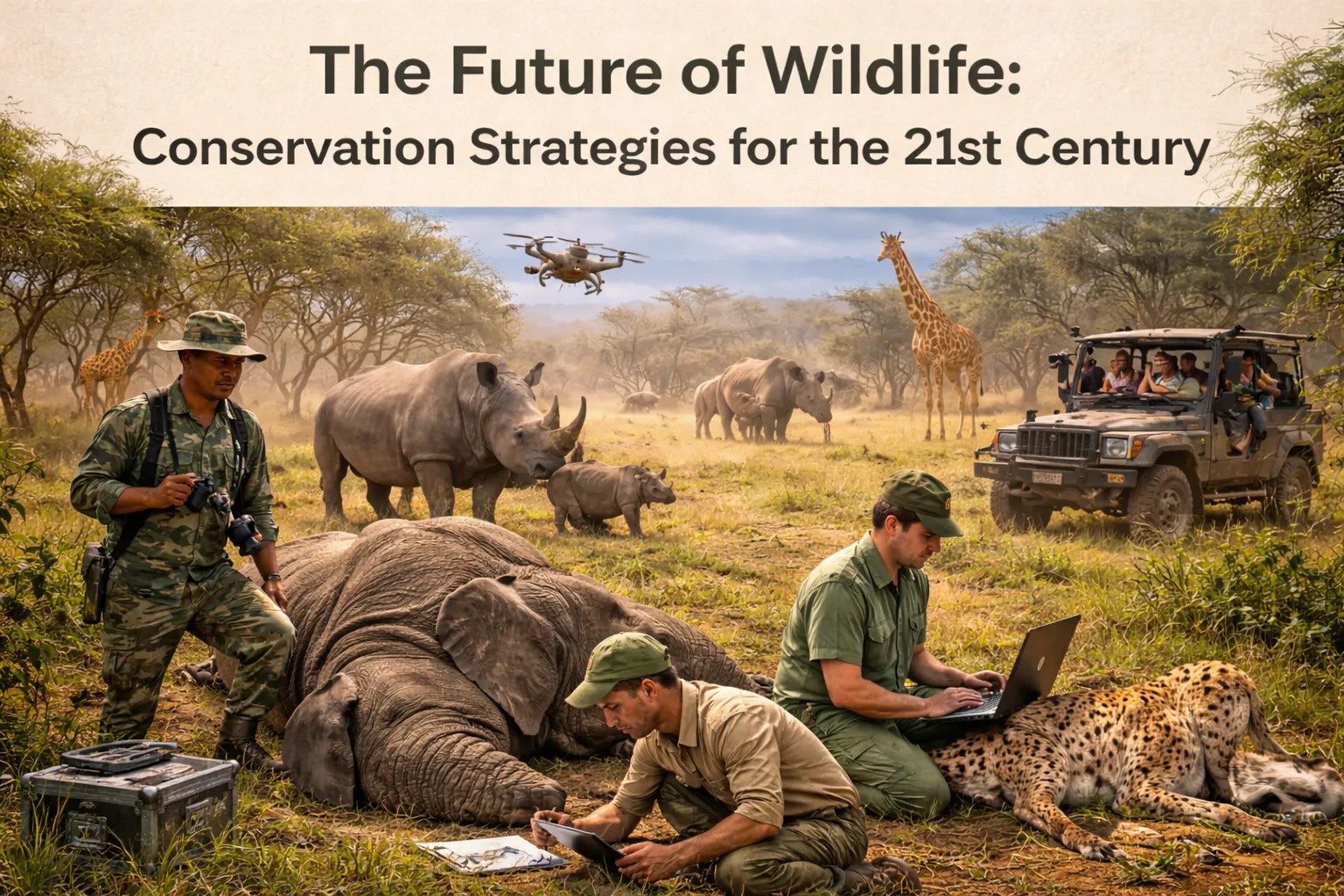
If fences prevent elephant migration during drought, mortality increases. Genetic bottlenecks may follow. Smaller, isolated herds struggle to adapt to disease outbreaks. In 2024, hemorrhagic disease outbreaks in parts of India highlighted the vulnerability of clustered wildlife populations. For a broader perspective on long-term protection strategies, explore The Future of Wildlife: Conservation Strategies for the 21st Century.
Balancing Conservation and Connectivity
Why Fences Were Built
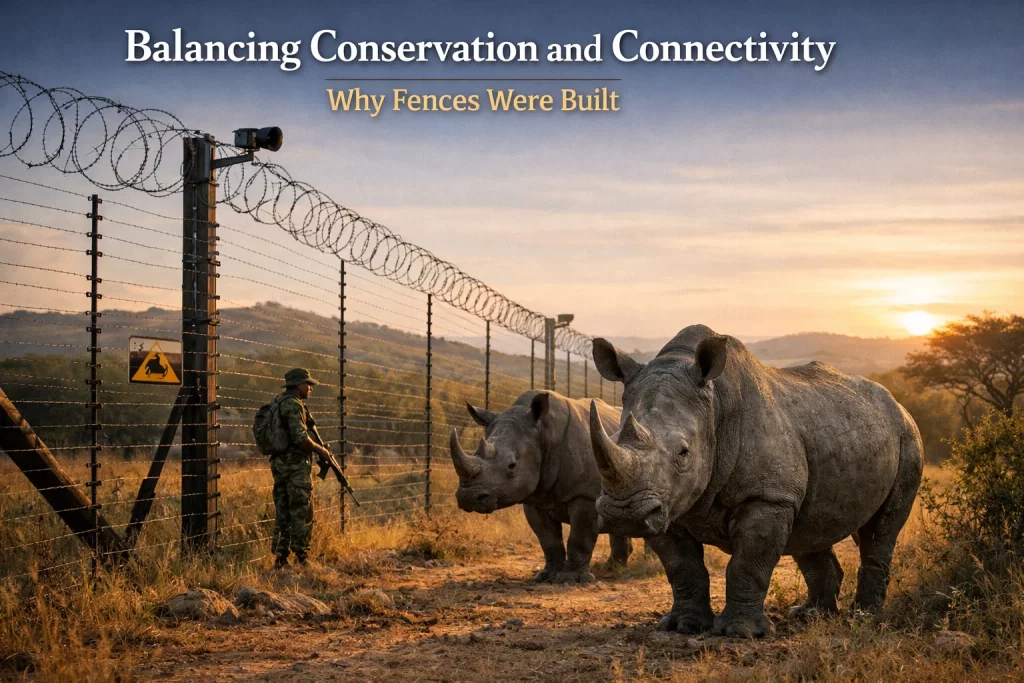
Fences serve important conservation goals. They protect endangered species from poaching. South Africa reduced rhino poaching inside heavily fenced reserves by more than 20% between 2023 and 2025.
Fences also reduce livestock disease transmission. Veterinary fences in Botswana were originally built to control foot-and-mouth disease. These measures protect rural livelihoods and food systems.
However, conservation must balance protection with movement. Elephant migration supports ecosystem health, seed dispersal, and predator-prey dynamics. A protected but isolated population cannot remain genetically stable forever.
Smarter Solutions for 2026
Conservation science now promotes wildlife corridors instead of complete enclosures. The Kavango–Zambezi Transfrontier Conservation Area connects five countries and spans 520,000 square kilometers. It represents one of the largest cross-border landscapes supporting elephant migration.
India has identified 88 elephant corridors as of 2026. The Wildlife Trust of India reports that securing these corridors reduces conflict and restores connectivity. Data from 2024 shows a 12% drop in conflict cases in regions where corridors replaced rigid fencing. Technology is helping reduce human-wildlife conflict. See how thermal technology is saving the African Rhino.
Key strategies include:
- Removing redundant internal fences.
- Installing wildlife-friendly fence designs.
- Protecting cross-border corridors.
- Using GPS tracking to map elephant migration routes.
- Engaging local communities in corridor planning.
Data Snapshot: Fences and Elephant Migration
| Metric (2026) | Africa | Asia |
|---|---|---|
| Wild elephant population | 415,000 | 52,000 |
| Estimated fenced protected areas | 60% in southern Africa | 3,000+ km electric fences in India |
| Documented genetic structuring | Moderate to high in fenced reserves | Significant within protected areas |
| Identified wildlife corridors | KAZA: 520,000 sq km | 88 recognized corridors |
| Annual travel distance | Up to 1,000 km | 500–800 km |
Bottom Line
Elephant migration remains essential for survival in 2026. Fences protect wildlife and communities, yet poorly planned barriers create long-term risks. Scientific evidence confirms reduced gene flow in fenced populations within just two generations.
Conservation must shift from isolation to connectivity. Corridors, cross-border reserves, and wildlife-friendly fencing offer balanced solutions. Climate change and habitat loss already pressure elephants. We cannot afford to restrict elephant migration further.