Table of Contents
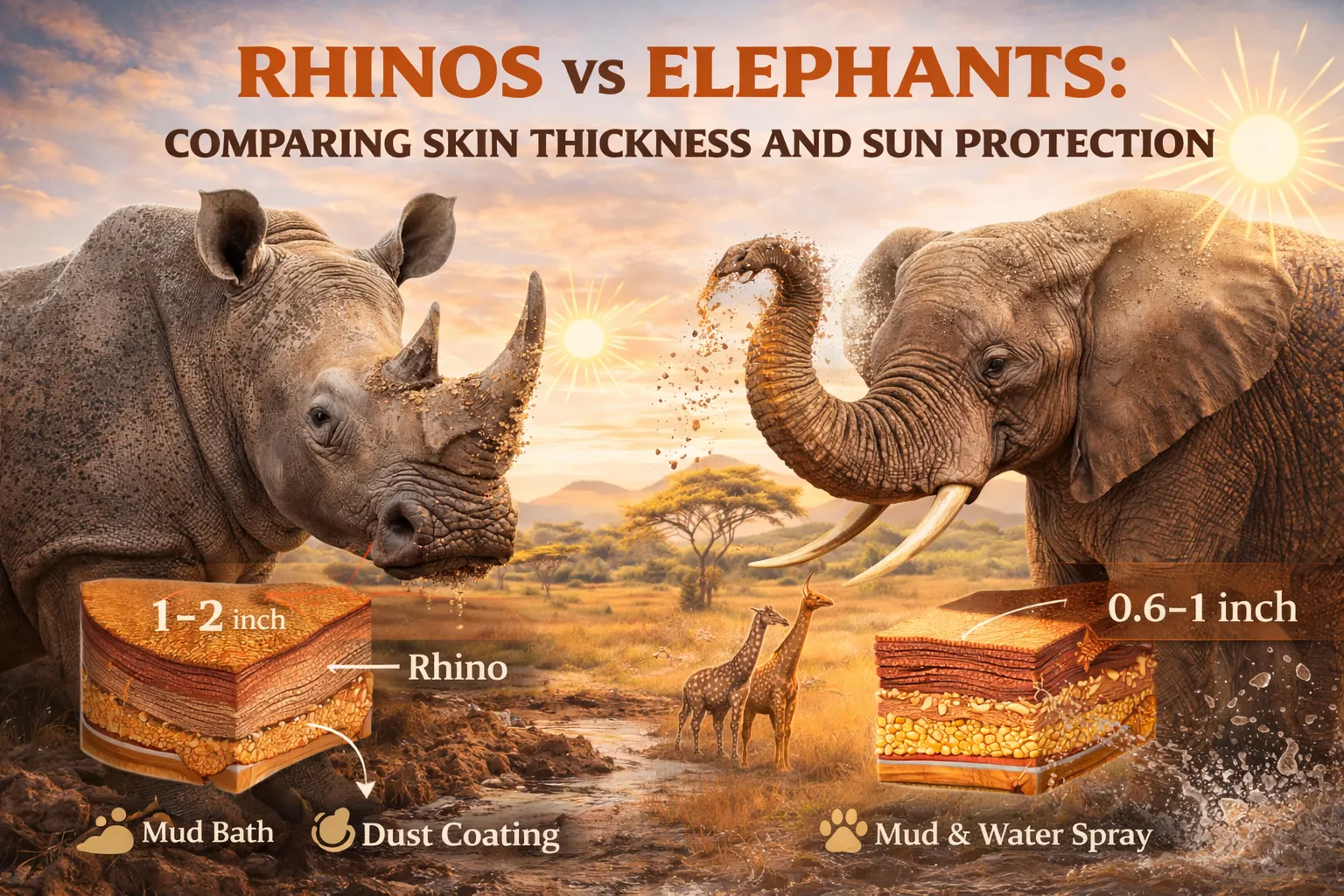
Rhinos vs Elephants is one of the most searched wildlife comparisons online, and for good reason. These two giants dominate African and Asian landscapes. Both can weigh over 5,000 pounds, both face harsh sun exposure, and both evolved thick skin to survive extreme climates. But when we compare skin thickness and sun protection, the differences become surprisingly clear.
African elephants can weigh up to 6,800 kg (15,000 pounds), while white rhinos reach about 2,400 kg (5,300 pounds). Despite size differences, both species rely heavily on skin structure for survival. Skin protects them from heat, parasites, injury, and UV radiation. As of 2026, African savannas regularly record surface temperatures above 122°F (50°C). In these conditions, skin becomes a life-saving adaptation.
Understanding Rhinos vs Elephants is not just about strength. It is about biology, climate survival, and evolutionary strategy. Let us break down how their skin works and why it matters in the wild.
Skin Thickness: Armor vs Flexibility
Elephant Skin Structure
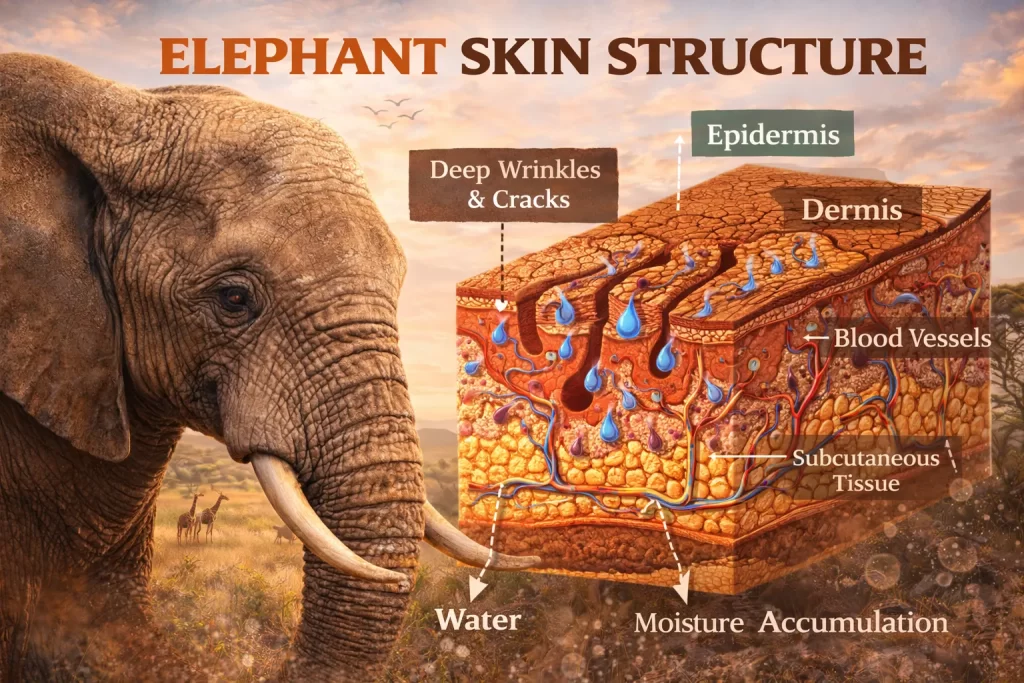
Elephant skin looks thick and cracked, but it is not solid armor. African elephant skin averages 2.5 cm (1 inch) thick. Some areas, like the back and head, are slightly thicker. The skin is deeply wrinkled, which increases surface area. Those wrinkles trap moisture and mud, helping regulate body temperature.
Research published by the University of Geneva in 2018 confirmed that elephant wrinkles retain up to 10 times more water than smooth skin. That retained moisture cools the body for longer periods. This design supports elephants in open savannas with intense sunlight.
Asian elephants have slightly smoother skin but follow the same cooling principle. The takeaway is clear: elephant skin prioritizes cooling efficiency over brute thickness. Interested in other herbivore adaptations? Learn how giraffes digest food through their four-chambered stomach system.
Rhino Skin Structure
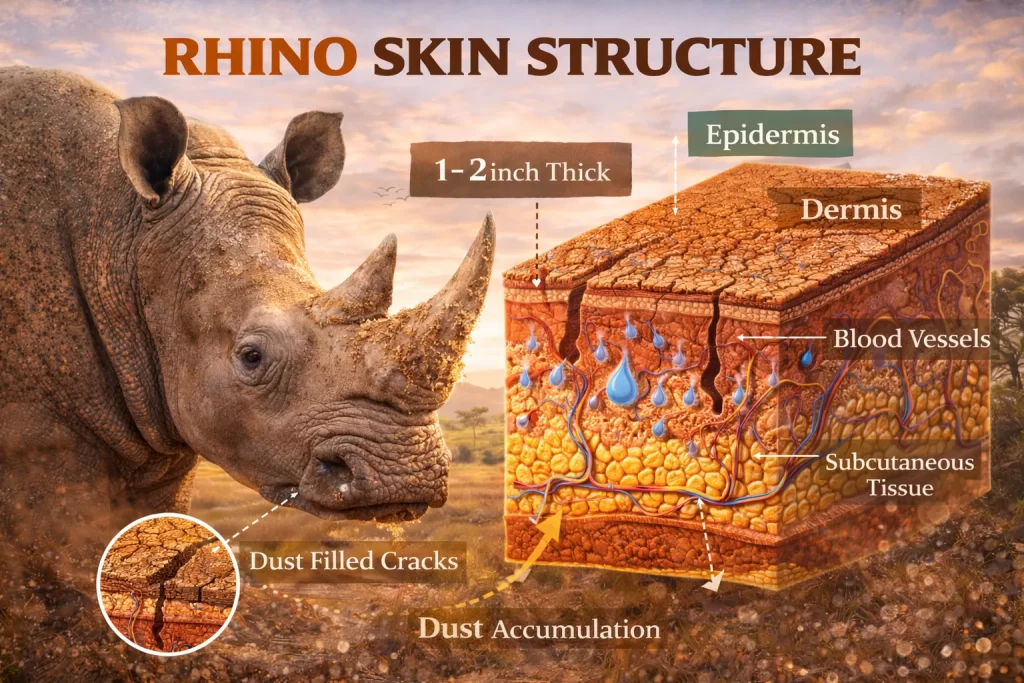
Rhino skin feels like natural body armor. It averages 1.5 to 5 cm thick, depending on species and body region. White rhinos have especially dense skin around the shoulders and flanks. This thickness protects them during fights, especially between males.
Unlike elephants, rhinos’ skin forms heavy folds that resemble armor plates. However, it is still sensitive to sunburn and parasites. Despite the myth, rhino skin is not bulletproof. It is tough but flexible.
Black rhinos, which inhabit bushy terrain, rely on skin durability to push through thorny vegetation. In the debate of Rhinos vs Elephants, rhinos win in pure skin thickness, but elephants excel in cooling adaptation.
Sun Protection Strategies in Harsh Climates
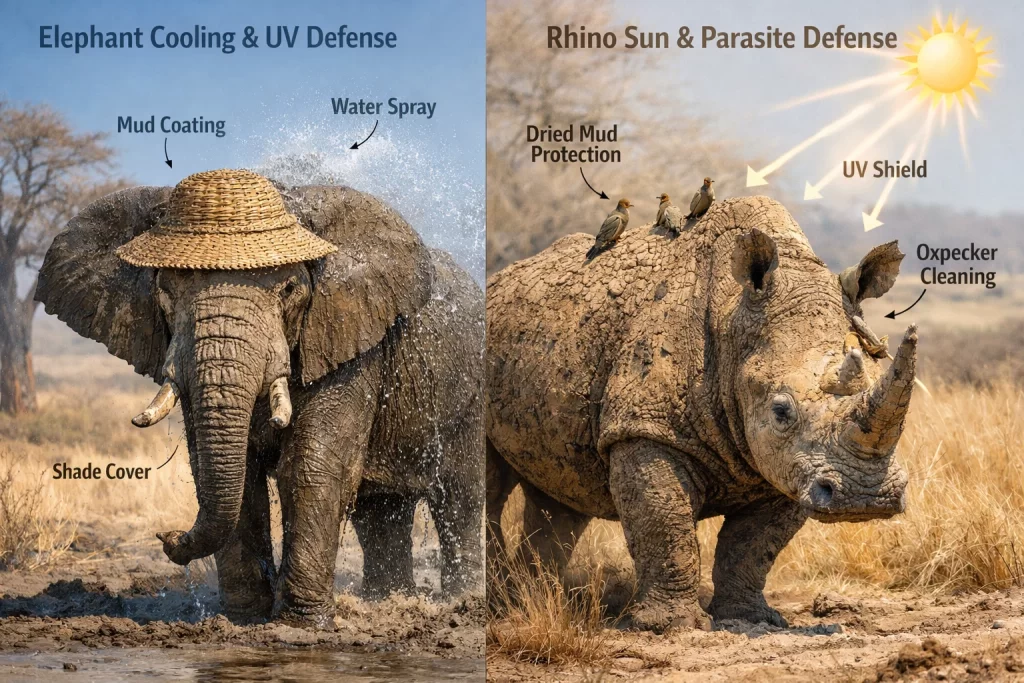
Elephant Cooling and UV Defense
Elephants live in direct sunlight for most of the day. Their skin alone cannot block UV radiation completely. So they use behavior to compensate. Dust bathing and mud coating act as natural sunscreen.
Elephants also flap their ears to release excess heat. An African elephant’s ears can span up to 2 meters (6.5 feet). Blood vessels in the ears help dissipate heat rapidly. According to data from the African Wildlife Foundation in 2025, elephants can lower their body temperature by several degrees Celsius through ear cooling alone.
In the comparison of Rhinos vs Elephants, elephants rely on active thermoregulation. Their sun defense combines skin structure, water retention, and behavioral adaptation. Rhino health varies globally. Read about the difference between African and Indian rhinoceros health requirements.
Rhino Sun and Parasite Defense
Rhinos depend heavily on mud wallowing for sun protection. Mud creates a thick protective layer against UV rays and insects. Once dry, it forms a crust that shields sensitive areas.
Rhinos often partner with oxpecker birds, which remove ticks and parasites. This relationship reduces skin irritation and infection risk. According to Save the Rhino International, updated 2026 data shows that rhinos in open reserves spend significant daily time near water for wallowing.
In Rhinos vs Elephants, rhinos use passive protection strategies. Their thicker skin offers impact resistance, but sun defense relies heavily on mud behavior.
Side-by-Side Comparison
| Feature | Elephants | Rhinos |
|---|---|---|
| Average Skin Thickness | 2.5 cm | 1.5–5 cm |
| Skin Texture | Deep wrinkles | Thick folds, armor-like |
| Cooling Method | Ear flapping + wrinkles | Mud wallowing |
| UV Protection | Dust + mud layers | Heavy mud coating |
| Parasite Defense | Dust baths | Mud + oxpeckers |
| Weight (Max) | 6,800 kg | 2,400 kg |
This table clarifies the practical differences between rhinos and elephants. Each evolved skin suited to its environment.
Population Context and Environmental Pressure
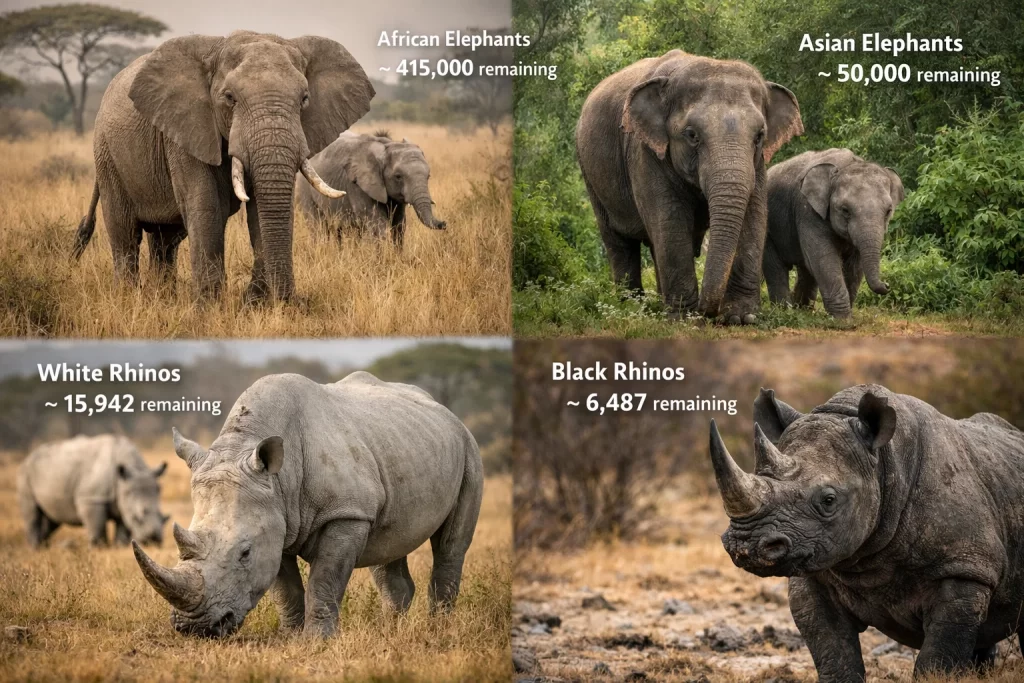
Today, environmental stress shapes skin adaptation. According to the International Union for Conservation of Nature, updated 2026 figures show:
- African elephants: about 415,000 individuals remain.
- Asian elephants: fewer than 50,000 remain.
- White rhinos: about 15,942 individuals.
- Black rhinos: about 6,487 individuals.
These numbers come from iucnredlist.org, updated species assessments through 2025. Habitat loss increases heat exposure in fragmented landscapes. That pressure makes natural sun protection even more critical.
In Rhinos vs Elephants, survival now depends not only on skin biology but also on conservation success.
For deeper behavioral insights, updated wildlife data can also be found at nationalgeographic.com and worldwildlife.org, which regularly report species updates through 2026. To see how this species compares within Africa’s iconic animal groups, explore our full breakdown of The Big Five and The Ugly Five.
Bottom Line
When we compare Rhinos vs Elephants, skin tells a powerful evolutionary story. Rhinos developed thicker, armor-like skin for combat and bush survival. Elephants evolved wrinkled skin optimized for cooling in open, sun-exposed habitats.
Both rely heavily on mud as a natural sunscreen. Both remain vulnerable to climate extremes and habitat loss. Yet their biological strategies differ sharply.