
Table of Contents
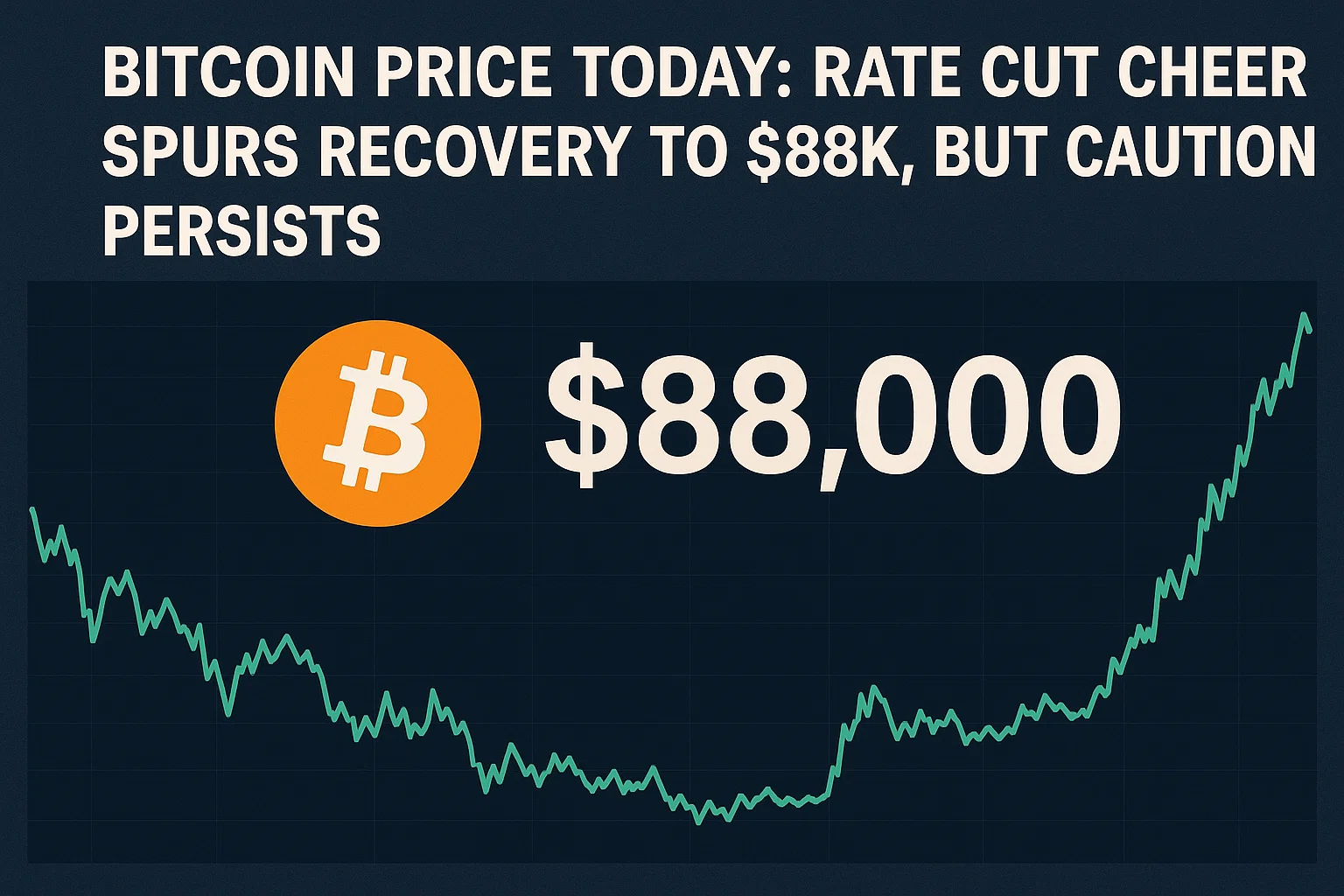
Bitcoin bounced back above $88,000 on Tuesday as Federal Reserve rate-cut hopes ignited renewed demand for risk assets across global markets. The world’s largest cryptocurrency rallied 0.8% to $88,187.90, marking its recovery from a seven-month low, though cautious investor sentiment suggests momentum could face headwinds.
Markets are now pricing in a 77.2% probability that the Fed will cut rates by 25 basis points in December up dramatically from just 41.8% the previous week. This shift has become the primary catalyst pushing Bitcoin above key resistance levels after weeks of sustained selling pressure.
Understanding Bitcoin’s Recovery: The Fed Rate-Cut Factor
Bitcoin’s comeback is fundamentally tethered to macroeconomic expectations rather than independent blockchain developments. When the Federal Reserve signals interest rate cuts, investors rotate capital from bonds and cash into higher-yielding assets like equities and cryptocurrencies. At least two Fed officials spoke publicly about December rate-cut possibilities, reshaping market pricing instantly.
According to CME FedWatch data, the consensus shifted sharply within seven days—a textbook example of how traditional monetary policy steers digital asset valuations. This connection demonstrates that Bitcoin no longer operates in isolation. Instead, it moves in tandem with risk sentiment, especially when real rates compress. The $88,000 level now represents a temporary floor where buyers stepped in aggressively, but the move remains fragile given institutional caution and retail exodus from crypto since October.
Why Institutional Investors Still Remain Wary
Despite rate-cut optimism, institutional demand continues weakening in real terms. U.S.-listed Bitcoin ETFs logged their fifth consecutive week of capital outflows, suggesting that even positive Fed signals aren’t yet convincing large money managers to re-enter aggressively. Between November 13-18, over 15,924 BTC flowed onto centralized exchanges, indicating spot selling by long-term holders.
This disconnect where macro sentiment improves but institutional flows deteriorate creates a vulnerability for Bitcoin’s rally. If next week’s economic data disappoints (producer inflation, retail sales, or PCE inflation), the 77.2% rate-cut probability collapses, and Bitcoin could lose its primary support. Investors should monitor Thursday’s PCE price index data closely, as any upside surprise strengthens the Fed’s inflation-fighting resolve and delays rate cuts indefinitely. Don’t miss our recent post about Lilly Hits $1 Trillion Valuation: What Rising Weight-Loss Drug Demand.
The December 9-10 FOMC Meeting: What’s at Stake
The Federal Reserve’s December 9-10 policy meeting represents the event most directly impacting Bitcoin’s near-term trajectory. Currently, markets assign 77.2% odds to a 25-basis-point cut during that session. If the Fed delivers as priced, Bitcoin could attempt a run toward $92,000-$95,000 resistance zones.
However, if inflation data turns hotter or employment remains resilient, the probability swings to a pause, triggering sharp selloffs across risk assets. Bitcoin’s behavior following the December meeting will likely determine whether this $88K level becomes a springboard or a dead-cat bounce. Historically, every 50-basis-point shift in Fed expectations produces 8-12% swings in Bitcoin valuations.
This November, traders witnessed that sensitivity firsthand when rate-cut bets doubled in 72 hours and Bitcoin surged nearly $3,000 simultaneously.
Bitcoin on Reddit’s BitcoinMarkets forum remain skeptical about sustaining single-digit daily gains in current conditions. The sentiment reflects broader exhaustion after October’s 22% monthly decline and November’s additional 14.7% drop from monthly highs. This caution despite Fed optimism underscores how damaged investor trust has become since the early-October flash crash that shocked retail traders and institutional funds alike.
Technical Resistance and the $88,000 Supply Zone
Bitcoin’s ability to clear $88,000 cleanly matters more than price levels alone suggest. Specifically, analysts identify a heavy supply cluster between $87,671 and $88,082 where approximately 55,567 BTC sit at breakeven prices. This 411 BTC zone worth roughly $4.83 billion at current prices—represents profit-taking resistance.
When Bitcoin rallies into these zones, holders offload positions to exit losses, capping upside momentum temporarily. Breaking decisively above $88,200 with strong volume would signal genuine buying conviction and potentially unlock a path toward $92,600. However, failing to hold above $88,000 could cascade down to secondary support near $84,449-$84,845, where $35.38 billion of Bitcoin remains anchored by cost-basis holders.
Technical analysts emphasize that the next 48 hours of price action will define whether this bounce extends or reverses.
| Level | Significance | Current Status |
|---|---|---|
| $88,200 | Major Resistance (Supply Cluster) | Critical Breakout Zone |
| $92,600 | Secondary Resistance (EMA Target) | Upside Extension Point |
| $95,900 | Key Historical Breakdown Level | Major Long-term Resistance |
| $84,449-$84,845 | Strong Support (Cost-Basis Floor) | Protective Level |
| $80,000 | Psychological Support & 7-Month Low | Capitulation Level |
Decoupling from Tech Stocks: A Worrying Sign for Bitcoin
Bitcoin’s decoupling from Nasdaq and technology stocks since early October signals waning correlation with traditional risk assets. Normally, when the Nasdaq rallies 2% (as it did on the day of Bitcoin’s $88K bounce), cryptocurrencies amplify those gains by 1.5x to 2x. Instead, Bitcoin lagged significantly, suggesting that Fed rate cuts alone cannot revive the sector’s appeal.
Altcoins supposedly higher-risk, higher-reward tokens fared better on the day, with Ethereum jumping 3.2% to $2,928.08 and XRP surging 8.7% to $2.2523. This divergence indicates that Bitcoin suffered more concentrated selling pressure than the broader crypto market, a bearish structural signal often preceding further consolidation rather than explosive rallies.
The Retail Fear Backdrop: Crypto Fear & Greed Index at Extremes
The Crypto Fear & Greed Index hit 11/100 recently—a reading last seen during the 2022 bear market collapse. This extreme fear persists even as rate-cut expectations surge, revealing deep skepticism among retail traders toward crypto’s recovery narrative. When macro sentiment improves but sentiment indices stay depressed, it typically signals that the sector has been so heavily sold that redemption narratives lose persuasive power.
Bitcoin’s $88,000 bounce provides marginal comfort, but the underlying emotional backdrop remains poisoned by October’s losses and November’s continued bleeding. True capitulation occurs when prices tank alongside extreme fear Bitcoin’s situation presents the inverse: prices rising amid extreme fear, which often precedes renewed selling as bargain hunters become disappointed buyers.
Producer Inflation and PCE Data: The Economic Wildcards
Tuesday’s producer inflation and retail sales figures, alongside Thursday’s PCE price index, will determine whether the 77.2% rate-cut probability holds or evaporates. The Federal Reserve watches PCE inflation more closely than any other price gauge, and hotter-than-expected prints could instantly reshape December’s meeting expectations.
A 0.3% monthly PCE increase or higher would signal persistent inflation despite rising unemployment claims and weakening retail spending. Such data would justify the Fed’s patient approach and push rate-cut odds back toward the 40% range seen just 10 days ago. Conversely, a cool PCE print around 0.2% would lock in December cuts and potentially spark Bitcoin’s next leg higher.
Institutional Capital Flight: When ETFs Turn Negative
U.S. spot Bitcoin ETFs (IBIT, FBTC, and others) logged five consecutive weeks of outflows through November. In absolute terms, this represents roughly $1.22 billion per week exiting institutional vehicles. This persistent hemorrhaging contrasts sharply with Q3’s inflows, when Bitcoin ETFs absorbed $25 billion and helped drive BTC from $56,000 to $113,000.
The shift underscores a critical reality: retail traders drove Q3’s rally, not institutions. Once October’s crash triggered panic liquidations, those same retail holders never returned with conviction, while institutions scaled back commitments systematically.
Bitcoin’s bounce to $88K faces this headwind directly every bounce without fresh ETF inflows signals that institutional players remain in wait-and-see mode rather than deploying capital offensively.
What Bitcoin Must Do to Sustain $88K: The Roadmap Ahead
For Bitcoin to build upon this recovery rather than fizzle into another false bounce, three conditions must align.
First, the Fed must deliver its December rate cut as currently priced (77.2% probability).
Second, Bitcoin must convincingly break above $88,200 with volume exceeding the three-month average, signaling institutional re-entry.
Third, economic data must improve or at minimum disappoint on the downside, keeping rate-cut expectations elevated through year-end. If all three conditions align, Bitcoin could target $92,600-$95,900 by late December.
If even one fails particularly a hawkish Fed pivot or weak ETF inflows Bitcoin reverts to support around $84,100-$85,000.
The Final Take
Bitcoin’s surge to $88,000 on rate-cut optimism represents a welcome relief after weeks of capitulation, but the rally remains fundamentally fragile. The Federal Reserve’s December meeting will determine whether this bounce extends into 2026’s bull market or collapses into another consolidation nightmare. Institutional outflows, retail fear, and technical resistance zones all suggest limited upside until economic data or Fed signals provide fresh conviction.
Disclaimer:
The information provided in this article is for general informational purposes only.