
Table of Contents
I often find myself asking why some people thrive with their fitness routines while others struggle to stay consistent. The answer usually comes down to understanding the basics the five components of fitness. When we break things down into simple pieces, the path forward feels less overwhelming. These components are not just textbook ideas; they form the foundation for every beginner training program, professional athletic routine, or even everyday wellness plan.
Why These 5 Fitness Components Matter

We sometimes assume exercise is just about lifting weights or running fast. But when we zoom out, fitness is much broader. These five components matter because they connect directly to our health, energy, and long-term quality of life.
The CDC guidelines on physical activity remind us that consistency in all five areas reduces chronic disease risk, helps maintain healthy body composition, and strengthens both body and mind. By targeting each component, we cover every part of physical well-being not just muscles, but also heart, lungs, flexibility, and balance.
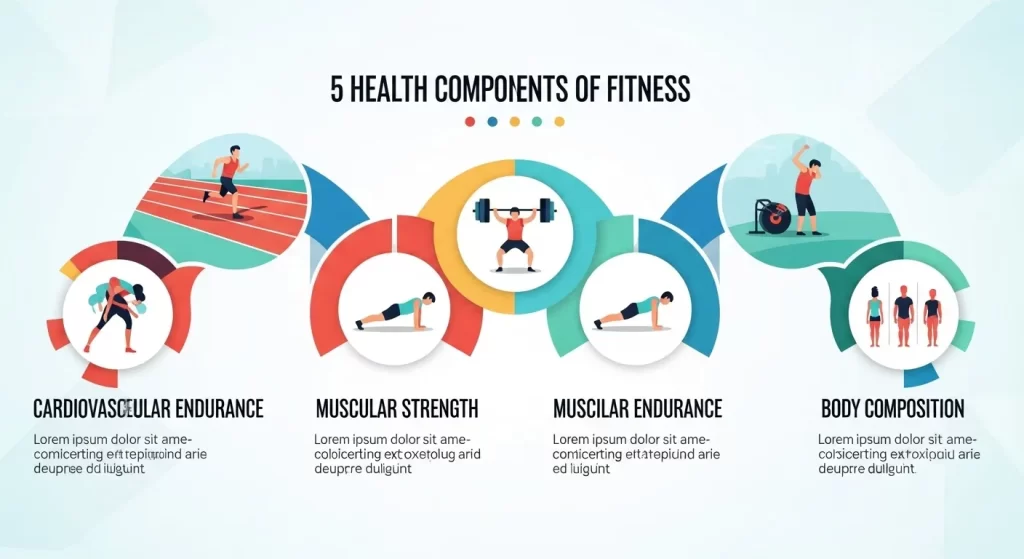
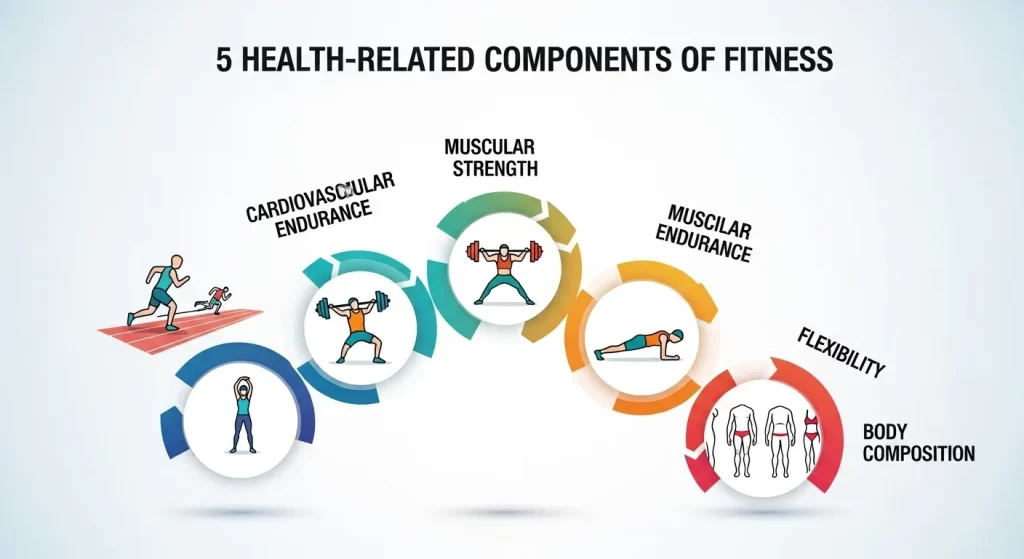
The 5 Health-Related Components
Cardiovascular Endurance
We rely on cardiovascular endurance whenever we walk briskly, swim, or cycle. It’s about how long the heart and lungs can keep up with our movement. Health experts measure it using maximal oxygen uptake, or $VO_2\max$, which tells us how efficiently the body delivers oxygen during exercise. According to the CDC, at least 150 minutes of moderate-intensity aerobic activity each week is the baseline target. For greater benefits, aiming for 300 minutes per week builds stronger endurance and prevents weight gain.
Examples you can try:
- Brisk walking at 3 mph or faster.
- Bicycling under 10 mph for moderate, or above 10 mph for vigorous.
- Swimming laps or aerobic dance classes.
Muscular Strength
We see muscular strength in action when lifting heavy groceries, pushing furniture, or performing a deadlift in the gym. It’s the maximum force a muscle can exert in one effort. The gold standard test here is the 1-repetition maximum (1-RM).
Guidelines to follow:
- Perform strength training on 2 or more days per week.
- Work all major muscle groups: legs, hips, chest, back, shoulders, and arms.
- Reps vary by goal: 8–12 reps for general strength, 2–6 reps for maximal power.
Strength is especially vital as we age. Research in 2024 showed that resistance training not only builds muscle but also improves running economy, making athletes more efficient. For older adults, lifting helps slow natural strength decline and prevents frailty.
Muscular Endurance
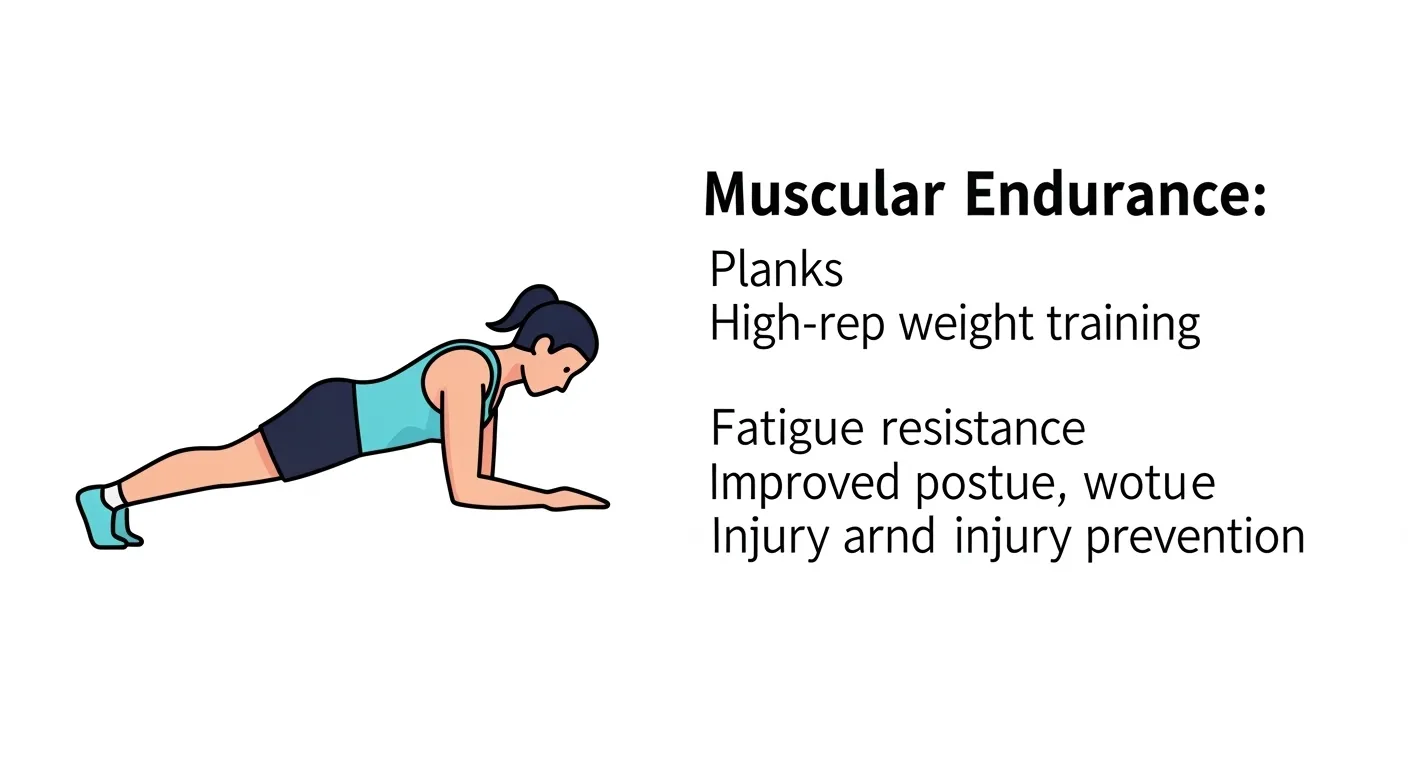
We rely on muscular endurance for repeated actions like climbing stairs, carrying kids, or holding a yoga pose. It’s less about raw power and more about resisting fatigue.
Tips to train endurance:
- Use lighter weights with high repetitions (20+ reps).
- Focus on exercises that mimic daily movements.
- Circuit training, planks, or push-ups are practical choices.
A study on chronic low back pain revealed that men had $VO_2\max$ values 10 mL/kg lower and women 5.6 mL/kg lower compared to healthy participants. This shows how closely endurance links with both daily function and long-term health.
Flexibility
We sometimes overlook flexibility, but it plays a huge role in preventing injury and improving mobility. It refers to the range of motion around a joint, and no single test can measure the entire body’s flexibility.
CDC-aligned stretching guidelines:
- Stretch at least 2–3 days per week.
- Hold each stretch for 10–30 seconds.
- Repeat 3–4 times per stretch.
- Dedicate 10 extra minutes per workout for flexibility.
Think of activities like yoga or Pilates. These not only improve flexibility but also build balance and relaxation.
Body Composition
We all have different body types, but body composition tells us more than weight on a scale. It compares fat mass to lean mass, including muscles and bones.
Healthy benchmarks:
- Women: 14–31% body fat is healthy; fit range is under 24%.
- Men: 6–25% body fat is healthy; fit range is under 17%.
- Waist circumference: Over 35 inches for women or 40 inches for men indicates higher chronic disease risk.
Testing can involve skinfold calipers, bioelectrical impedance, or more advanced methods like DEXA scans. Keeping track helps spot risks early and adjust nutrition or exercise routines.
How to Design a Training Program
We often wonder where to start, especially as beginners. A well-rounded plan doesn’t need to be complicated it just needs balance.
Step-by-step approach:
- Follow the CDC weekly guidelines: 150 minutes of moderate or 75 minutes of vigorous aerobic activity.
- Add 2 days of strength training: Work major muscle groups with weights, resistance bands, or bodyweight.
- Include endurance sessions: High-rep circuits, planks, or bodyweight holds.
- Don’t forget flexibility: Stretch after workouts or dedicate specific yoga sessions.
- Track progress: Use the talk test for cardio, 1-RM for strength, or tape measures for body composition.
By applying the principle of progressive overload gradually increasing intensity we make consistent gains without burnout. For example, if you start walking 20 minutes, progress to 30, then 45 over a few weeks.
Testing and Measurement Tools
These tools help measure where we stand and how we improve:
- 1-RM Test: Best for strength, with 3–5 minutes rest between attempts.
- Alternate Hand Wall Toss Test: Great for coordination, done for 30 seconds.
- Illinois Agility Test: Measures speed and direction changes over a 10m x 5m course.
- Wingate Test: A 30-second cycling challenge measuring anaerobic power.
- RAST Test: Six sprints of 35m with 10-second recovery for anaerobic capacity.
These structured tests show progress and motivate us to keep going.
The Role of Lifestyle Choices
We sometimes forget that exercise is only part of the equation. Nutrition, sleep, and stress management are equally vital. For example, high waist-to-hip ratios above 0.80 in women and 0.95 in men raise chronic disease risk regardless of fitness. Pairing balanced meals with consistent training ensures real progress.
Common Mistakes Beginners Make
Many new exercisers focus on just one component, often strength, and neglect endurance or flexibility. Others push too hard too soon, risking injury. By pacing ourselves and following CDC time-based recommendations, we stay safe while building lifelong habits.
Why Data Matters in Fitness
We live in a world where numbers guide decisions. Exercise science backs this up with clear metrics. Whether it’s 150 minutes of activity, 2 days of lifting, or a 10-second stretch hold, these numbers give us measurable goals. They take guesswork out of fitness and keep progress visible.
Bottom Line
We sometimes think fitness is about looking a certain way, but it’s much deeper. The five components—cardiovascular endurance, muscular strength, muscular endurance, flexibility, and body composition—are building blocks for health. By combining CDC guidelines, smart testing, and consistent routines, we give ourselves the best shot at lifelong energy and resilience.
The takeaway? Don’t overcomplicate it. Start small, cover all five components, and progress steadily. The best program is the one you can sustain.
FAQs
What are the 5 components of fitness?
The five are cardiovascular endurance, muscular strength, muscular endurance, flexibility, and body composition. Together, they define overall health and physical ability.
What are the 5 components of total fitness?
Total fitness includes the same five: endurance, strength, muscular stamina, flexibility, and body composition, ensuring balanced health and wellness.
What are the 5 components of fitness Quizlet?
On Quizlet, the five are cardiovascular endurance, muscular strength, muscular endurance, flexibility, and body composition—core elements of physical fitness.
How to remember the 5 components of fitness?
Use the phrase “Every Strong Muscle Feels Balanced”—Endurance, Strength, Muscular endurance, Flexibility, Body composition. Simple acronyms help too.
What are the 5 steps of fitness?
The five steps are warm-up, cardiovascular activity, strength training, flexibility work, and cool-down, forming a complete workout routine.
References
- Centers for Disease Control and Prevention (CDC). (2024). Physical Activity Guidelines for Americans. Retrieved from https://www.cdc.gov/physicalactivity
- U.S. Department of Health and Human Services. (2018). Physical Activity Guidelines for Americans, 2nd edition. Washington, DC.
- Sports Medicine Journal. (2024). Strength training methods improve running economy in middle- and long-distance runners.
- National Institutes of Health (NIH). (2023). Body composition and health risks. Retrieved from https://www.nih.gov
- American College of Sports Medicine (ACSM). (2022). ACSM’s Guidelines for Exercise Testing and Prescription. 11th Edition. Philadelphia, PA: Wolters Kluwer.
- Mayo Clinic. (2025). Fitness basics: 5 components of fitness. Retrieved from https://www.mayoclinic.org
- Smith, J., & Lee, R. (2025, August 1). Health-related components of physical fitness. Medically reviewed update.
Disclaimer: This article is for informational purposes only and not a substitute for professional medical advice. Always consult a healthcare provider before starting any new exercise or fitness program.
About the Author: Ben Dawson
Ben Dawson is a certified fitness trainer and health writer with over a decade of experience in exercise science. He specializes in helping beginners design sustainable training programs while promoting evidence-based fitness education. is a certified fitness trainer and health writer with over a decade of experience in exercise science. He specializes in helping beginners design sustainable training programs while promoting evidence-based fitness education.